 Brindlewood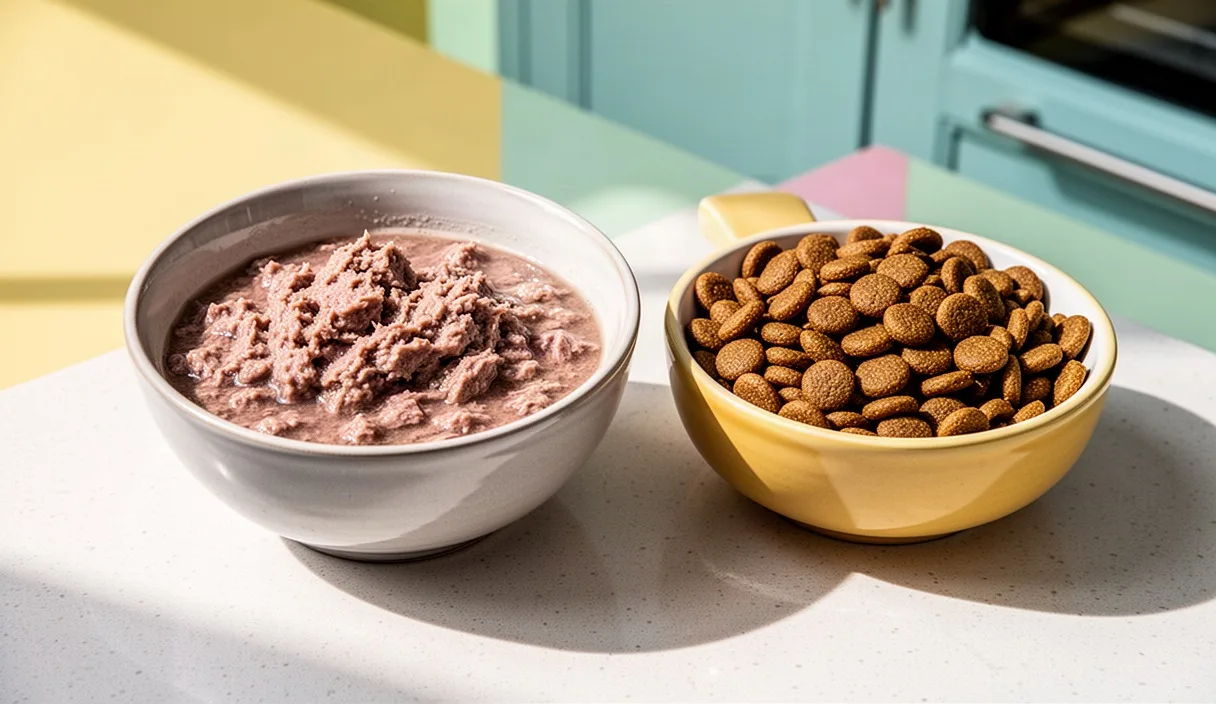
A cat's bowl holds one of two things, most days. Wet food, or dry food. The choice looks simple. It is not.
Texture is the obvious difference. Moisture, cost, storage, and daily rhythm matter more. This article walks through each one, with numbers, not opinions.
What separates wet food from dry, beyond texture
Dry food is baked or extruded, then dried down to a low moisture level. Wet food is cooked in a sealed can or pouch, sealed while still moist. The processes are different, and the end products behave differently in the body.
Dry food is calorie-dense. A typical kibble sits around 3.5 to 4 kilocalories per gram. Wet food sits lower, often 1 to 1.5 kilocalories per gram, because water takes up space without adding energy.
Protein source matters too. Many wet foods list a named meat or fish as the first ingredient, with less reliance on plant-based binders. Dry food needs starch or a similar binder to hold its shape during extrusion. This changes the carbohydrate percentage of the final product.
Neither format is automatically better. The right one depends on the cat, the household, and the budget. The sections below break down where the real differences sit.
Moisture content and daily water intake
Wet food is roughly 75 to 80 percent water. Dry food is roughly 6 to 10 percent water. That gap is the single biggest nutritional difference between the two formats.
Cats evolved from desert-dwelling ancestors. Their thirst drive is weak compared to dogs. A cat eating only dry food may not drink enough water to make up the difference, even with a bowl always full.
This matters most for urinary tract health and kidney function. A vet may recommend wet food, or a mixed diet, for a cat with a history of urinary crystals or early kidney concerns. This is a medical decision, and it should involve a vet, not a guess.
- A cat eating only dry food often drinks more water from a bowl, but total water intake still tends to land lower than a cat on wet food.
- A cat eating only wet food may barely visit the water bowl, because the food itself supplies most of the fluid.
- Running water, from a fountain-style bowl, can raise water intake in cats that are reluctant drinkers.
If a cat is healthy and drinks well, dry food alone is not automatically a problem. If a cat rarely drinks, or has had urinary issues before, moisture content becomes a practical factor to discuss with a vet.
Cost comparison per typical serving
Dry food is cheaper per calorie, in most cases. A 3.5 kg bag of mid-range dry food often costs between 18 and 28 dollars, and lasts a single adult cat four to six weeks.
Wet food costs more per calorie, because water and packaging add expense without adding energy. A 3 oz can typically costs between 1 and 2.50 dollars, and supplies roughly 70 to 90 kilocalories.
Here is a rough monthly comparison for a 4.5 kg adult cat needing about 250 kilocalories a day:
| Food type | Daily amount | Approx. monthly cost |
|---|---|---|
| Dry food only | about 65 g | 12 to 20 dollars |
| Wet food only | about 3 standard cans | 27 to 65 dollars |
| Mixed (half and half by calories) | varies by brand | 20 to 42 dollars |
These are estimates, not guarantees. Prices shift by region, brand tier, and whether the food is a limited-ingredient or prescription formula. A prescription wet food for kidney support, for example, often costs more than a standard adult formula.
Storage and shelf life differences
An unopened bag of dry food lasts many months, sometimes over a year, if stored in a cool, dry spot away from direct sunlight. Once opened, though, the clock changes.
Opened dry food stays reasonably fresh for about four to six weeks, if kept in a sealed container. Left in an open bag, exposed to air, fat in the kibble can turn rancid within two to three weeks, even if it still looks fine.
Wet food has a longer unopened shelf life than most people expect, often one to two years, because the can or pouch is sealed during cooking. Once opened, the rules tighten fast.
- An opened can of wet food should go in the fridge, covered, and used within two to three days.
- A can left out at room temperature for more than an hour or two, especially in warm weather, should be discarded rather than served.
- Small pouches or pate cups, sized for one meal, avoid the leftover problem entirely, at a higher cost per calorie.
For households that travel often, or forget to refrigerate leftovers, dry food's longer window is a practical advantage. For households with a fridge nearby and a routine of same-day feeding, wet food's shelf life is not really a burden.
Fitting food type to a household routine
A single-cat household with a predictable schedule can manage either format without much friction. A multi-cat household, or a busy one, often finds one format easier than the other.
Dry food works well with automatic feeders. A timed dispenser can portion kibble accurately, at set hours, without spoilage risk. This suits households where no one is home at midday.
Wet food needs a person present, or close to present, at feeding time. Food left out too long invites bacteria growth and, in warm climates, flies. A cat that grazes on wet food left out for six hours is not eating fresh food by hour four or five.
Multi-cat households add another layer. Wet food bowls need to be separated, or one cat may guard the food and block another from eating. Dry food left out for free grazing avoids that particular conflict, though it can create its own problem: overeating in a cat with no self-limiting instinct around kibble.
When a mixed approach makes sense
A mixed diet, wet food once or twice a day plus dry food available between meals, is common and workable for many cats. It combines the moisture benefit of wet food with the convenience and lower cost of dry food.
A typical split looks like one small can of wet food in the morning, dry food available through the day in a measured amount, and the calorie totals adjusted so the cat is not simply eating more overall. The measured part matters. Mixing the two without adjusting portions is a common way weight creeps up over months.
A vet or a feline nutrition guide on the food packaging can help calculate the right calorie split for a specific cat's weight and activity level. This is not a one-size answer, and a cat recovering from illness, or an overweight cat, may need a stricter plan than a healthy adult.
Common mistakes
- Leaving wet food out for hours, assuming a cat will "graze" on it safely, the way it might with dry food.
- Switching formats abruptly, which can upset digestion; a gradual transition over five to seven days is gentler.
- Assuming a cat drinks enough water on dry food alone, without checking the water bowl level day to day.
- Free-feeding dry food with no portion control, then being surprised by weight gain months later.
- Choosing a format based on price alone, without checking whether a cat's health history calls for extra moisture.
Next steps
Start by checking what a cat currently eats, and how much water it actually drinks in a day. A kitchen scale and a marked water bowl make this easy to track for a week.
If a cat has a history of urinary trouble, kidney concerns, or is reluctant to drink, raise the moisture question with a vet before changing anything. If a cat is healthy and eating well, a mixed approach, adjusted for calories, is a reasonable middle ground to try.
Whatever the choice, recheck it every few months. A cat's needs at two years old are not the same as at twelve, and the right food today may not be the right food later.