 Brindlewood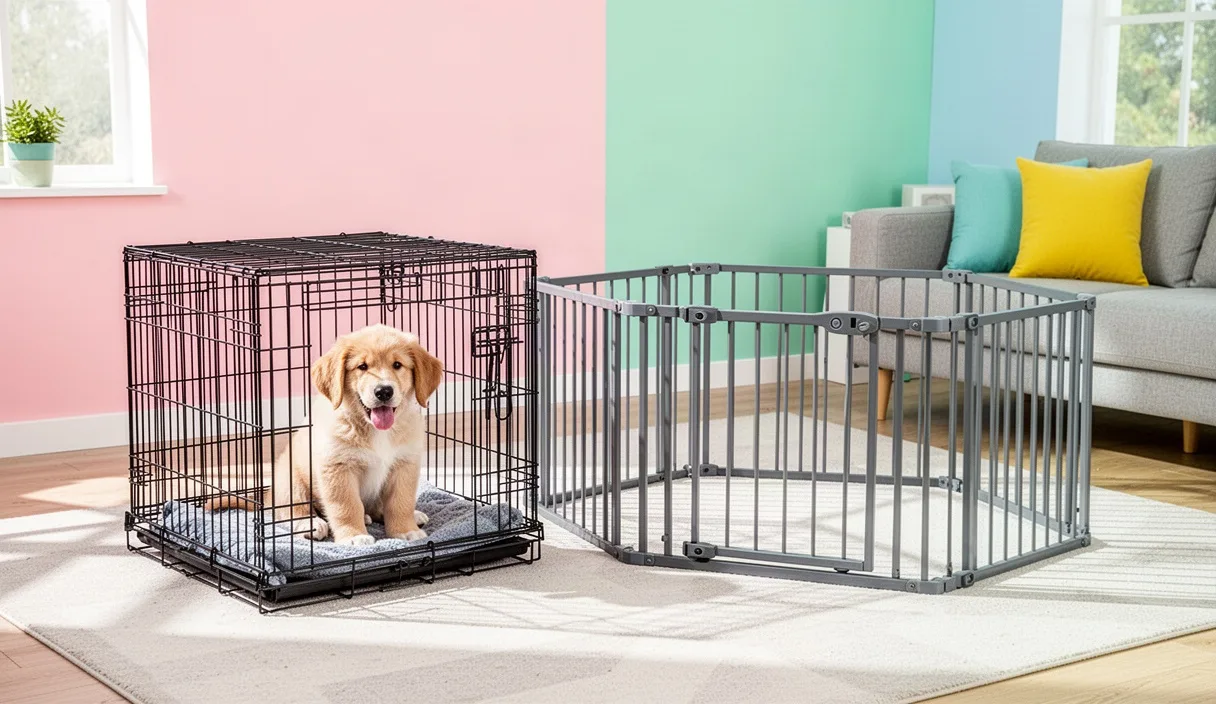
A crate is a box. A pen is a room within a room. Both hold a dog when you can't watch it.
The choice is not about which method is kinder. It is about which one fits the walls you already have, the hours you already keep, and the dog in front of you. This guide walks through both, side by side, so you can decide with facts instead of guesswork.
What crate training involves day to day
A crate is sized to the dog. Enough room to stand, turn, and lie flat. Nothing more. That size limit is the whole point: it discourages accidents by making the sleeping area too small to separate from a bathroom corner.
Most days start with a short crate stay after breakfast, while dishes get washed or a bag gets packed. The dog goes in on cue, gets a treat, and the door closes. Sessions build slowly. Ten minutes in week one. Thirty minutes by week two. An hour or more by the end of the first month, for a healthy adult dog.
A crate-trained routine usually includes:
- A consistent phrase for entering, such as "kennel" or "crate."
- A chew or stuffed toy left inside, reserved only for crate time.
- A bathroom break immediately before and after each stay.
- No release while the dog is barking or scratching, to avoid rewarding the noise.
Puppies under six months cannot hold a bladder for long. A rough rule: one hour of crate time per month of age, up to about four hours. An eight-week-old puppy should not be crated for a full workday. A professional trainer or veterinarian can help set a realistic schedule for a specific puppy.
What pen training involves day to day
A pen is larger. Four feet by four feet at the small end, sometimes a whole laundry room or bathroom. It holds a bed, a water bowl, and often a pee pad or turf patch at the opposite corner from the bed.
The daily rhythm looks different from crate life. The dog is not asked to hold anything for hours. It has options inside the pen: sleep, chew, or use the pad if no one is home to open the door.
A pen-trained routine usually includes:
- A bed on one side, a bathroom surface on the other, kept several feet apart.
- Water available at all times, since stays run longer than crate stays.
- Toys rotated every few days to keep the space interesting.
- A gradual reduction in pad size as house training improves.
Pens suit dogs that panic in small enclosed spaces. They also suit households that are gone nine or ten hours at a stretch, where no crate schedule would be fair to the dog's bladder.
Space requirements for each
Crates take a corner. A medium crate for a 40-pound dog measures roughly 36 inches long. It fits under a desk, beside a couch, or in a bedroom without blocking a walkway.
Pens take a room, or close to it. An exercise pen for the same 40-pound dog needs at least six feet by six feet to include a bed, water, and a separate bathroom zone. Some households use a spare bathroom or a section of a mudroom. Apartments with open floor plans sometimes struggle to find that much dedicated square footage.
| Factor | Crate | Pen |
|---|---|---|
| Footprint | 2 to 4 square feet | 16 to 36 square feet |
| Portability | Foldable, easy to move between rooms | Heavier, usually stays in one spot |
| Fits small apartments | Yes, in most cases | Only with a spare room or wide hallway |
| Works for two dogs | Needs two separate crates | Can sometimes house two dogs in one large pen |
Renters should check with a landlord before installing a permanent pen setup, since some pens attach to walls or floors with anchors.
Matching the method to work and sleep schedules
A crate fits a schedule with breaks. Someone home at lunch. A dog walker who arrives midday. A remote work setup with regular pauses. The dog is never asked to hold longer than its age and health allow.
A pen fits a schedule without breaks. A commute of an hour each way. A job with unpredictable overtime. A household where no one can guarantee a midday visit. The pen absorbs that uncertainty because the dog has a bathroom option built in.
Sleep schedules matter too. Many owners keep a crate in the bedroom overnight, even if a pen is used during the day. The dog learns two settings: a small space for quiet sleep, a larger space for active alone time. Some owners skip the crate at night once a dog is reliably house trained, and let it sleep loose in the bedroom instead.
Shift workers face a harder puzzle. A night-shift schedule might mean the dog is alone from 11 p.m. to 7 a.m. A pen with a pad handles that stretch more reasonably than a crate would, for most adult dogs.
Cost and setup differences
A basic wire crate for a medium dog runs somewhere between 40 and 90 dollars. A crate pad adds another 20 to 30 dollars. Total first-time cost usually stays under 150 dollars.
A pen costs more upfront in most cases. An exercise pen panel set runs 60 to 150 dollars depending on height and material. A bed, pee pads or a turf box, and a washable floor mat add another 60 to 100 dollars. Total setup often lands between 150 and 300 dollars.
Ongoing costs differ too:
- Crates need almost no recurring purchases beyond an occasional replacement pad.
- Pens with pee pads need a steady supply, often 20 to 40 dollars a month until house training is complete.
- Turf-based pen setups cost more upfront but less over time, since the turf is rinsed and reused.
Neither option requires professional installation. Both can be assembled in under thirty minutes with basic tools or none at all.
Signs one method isn't working
A crate that isn't working shows itself through the dog's body. Constant panting, drooling on the crate bars, or repeated escape attempts point to distress rather than simple boredom. Some dogs never adjust to that level of confinement, and a pen becomes the better fallback.
A pen that isn't working shows itself through the floor. If accidents happen far from the pad, or the dog chews through the pad and scatters it, the space may be too large for the current stage of house training. Shrinking the pen, or returning to a smaller crate for part of the day, often resolves this.
Watch for these warning signs with either method:
- Bleeding gums or broken teeth from chewing at bars or panels.
- Weight loss or refusal to eat while confined, suggesting the space feels unsafe.
- Nonstop barking that continues for the entire duration of a stay, not just the first few minutes.
- Injuries around the paws or muzzle from repeated attempts to dig or push through an opening.
Any of these signs, especially injury or refusal to eat, calls for a conversation with a veterinarian or a certified trainer rather than a longer trial period at home.
Common mistakes
Owners often size a crate for the puppy the dog will become, not the puppy it is now. A crate too large defeats the bathroom-training benefit, since the dog can soil one end and sleep in the other.
Owners also skip the short sessions and jump straight to an eight-hour crate day. That gap between zero and eight hours usually causes the exact panic or accidents the method was meant to prevent.
With pens, a common mistake is placing the bed and the bathroom surface too close together. Dogs avoid soiling near where they sleep, so a cramped pen layout with both in the same corner does not give the dog a real choice.
A final mistake applies to both methods: using the space as punishment. A crate or pen door should never close right after a scolding. That timing teaches the dog to fear the space itself, not the behavior that caused the scolding.
Next steps
Measure your dog first. Nose to tail, plus a few inches, sets the crate size. Add a few feet in each direction for a pen.
Write down your actual weekly schedule, hour by hour, for one typical week. Compare that schedule against the bathroom-holding guidance for your dog's age and health.
Start with short sessions no matter which method you pick. Five to ten minutes on day one. Build from there over one to two weeks.
If accidents, panic, or injury show up early, pause and call a veterinarian or a certified trainer before extending the sessions further. A short conversation now often saves weeks of frustration later.